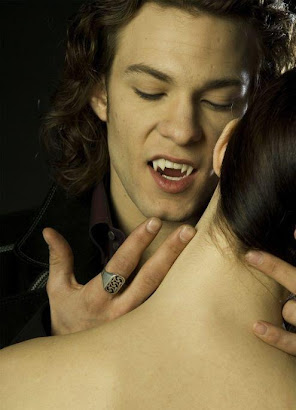
… but I wouldn’t want to be one!
... (continued from part 1)Is it that I feel this way (liking vamps, but not wanting to be one) because I’m female?
And I deduced the answer to that, (as it pertains to me anyway), is indeed a resounding YES!
Why?
‘Cause when I think: Vampire, being a heterosexual female, I think: Male, when I think male, I think: Seduction and who isn’t a sucker (no pun intended) for seduction when it comes to vamps? And as we know, it’s all about the seduction, n’est pas?
Case in point, my mind automatically goes (to name a few): to Lestat and Dracula (Gerard Butler’s version anyway in Dracula 2000) and Bill Compton (True Blood) and Angel and Spike (from Buffy) and Henry ( as portrayed by Kyle Schmid in Blood Ties) and David (The Lost Boys) and D (Vampire Hunter D) and yes, even to the fangless Edward Cullen (but only to an extent).
Bear in mind dear reader, that several of these examples are the quote/unquote “romanticized” version of the traditional vampires of yore.
But nonetheless, there is something to be said for the power exuded by these seductively fascinating creatures.
Vampires are the ultimate predator. And considering that most vampires are usually depicted as having been human before their transformation, and some (though not all) ultimately retain their souls (Blood Ties, vampire Henry Fitzroy is an example of such) – then the danger associated with them adds to the seductive quality. It translates basically to the fact that, if he so chooses, a vampire could as easily kill you, as much as just take some of your blood.
Unlike other creatures, who most times, would undergo some intense physical transformation – for example, the man turning into beast, that the quintessential Werewolf (often times depicted as the arch enemy of the vampire) – most vampires’ physical transformations are usually more subtle (the vampires of Buffy and The Lost Boys are among the few exceptions).
Glowing eyes, fangs, pale (sometimes cold) skin - despite these differences, at any given time, a vampire could continue to pass unnoticed among humans, and there in lies an added danger, which again, adds to the seduction.
To quote film critic Maitland McDonagh (on a recent Space: the Imagination Station special – Pretty Bloody: The women of Horror, © 2009): “Vampires have always been the mainstay of women in horror… explicitly tied with ideas of seduction and of giving into impulses that are perhaps socially unacceptable… Vampires are very sexualized. …not the brutal sexuality of say Werewolves, who are the embodiment of the beast within…. Vampires are seducers....”
Furthermore, there is no escaping the implied (or explicit) sexual connotations associated with most vampires, especially those of the fanged variety (here Edward Cullen and the other Twilight vamps do not apply).
Vampires’ fangs: the long, pointed, sharp teeth of its mouth (usually incisor, some times canines, other times both), are meant to penetrate. To penetrate the (preferably human) flesh from which it must get blood to the sustain itself. And the parts of the body usually preferred by vamps, where the veins run deep and strong, are also some of the parts of the body where one would find (some of the most sensitive) erogenous zones: the neck, wrist, inner thigh and to a lesser extent breasts.
Thus when it comes to the vampire and the act of taking blood (fangs penetrating the barrier of the flesh), there can be no denying the parallels to the physical act of sex.
And this is especially brought to more evidence, if the vampire takes blood whilst engaging in said act. (There are however some exceptions, i.e. vamps which are physically sexually impotent. For example: Anne Rice’s vampires have no use of their sexual organs after being turned. Nevertheless, the fang penetration connotation still applies.)
Then there is the being desired.
There is definitely something to be said for being the object of want and desire to a vampire. True is may be for the blood that lies beneath (the body). But to know that in essence the vampire literally can’t live without “You”. Well!
As a warm and red blooded woman, I find that thought rather appealing, in spite of the apparent danger. And again the sense of danger adds fuel to the seductive fire that is the modern image of the vampire.
To conclude, as much as I wouldn’t want to be a vampire, the thought of being on the receiving end of a vampire’s attention can have its appeal.
Of course, the idea behind this sentiment is in the context of the romanticized fantasy perpetuated by many (mostly female) authors of the genre. And is reiterated in most of the vampire based films and Tv shows we see today.
In fact, even yours truly has penned a poem or two with emphasis on the sensual/seductive/dangerous/erotic appeal of the vampire. As in My Life, My Love, My Blood , (recently featured on Roxanne Rhoads’ Fang-tastic books blog).
But what say you dear reader: What is it about the vampire (or the genre that appeals to you)? And in the context of the statement, would you like being the vampire or its vassal?
I invite you to leave your comments below.


.jpg)


 Posts
Posts